Now in the Claude connector directory
AI that thinks
like a scientist
Bring a result from the bench or a question from the field. BioSkepsis reads the literature in full and gives you a cited, verifiable answer scored on a Trust Index.
Interpret my result
What agrees, what conflicts, likely mechanisms, caveats, and the next experiment.
Research a question
A fully worked, evidence-backed brief: target dossiers, state of the field, mechanisms.
Used by scientists across academia and industry.












Swipe for more
How it works
Built like a careful researcher
BioSkepsis is an agentic AI that runs the whole check for you: it understands your result or question, plans the search, reads the literature in full, weighs agreement against conflict, screens for reliability, and returns a cited, verifiable verdict.

Understands your result
Reads your result, the system, the perturbation and what you measured, and turns it into the questions the literature has to answer.
Plans the check
Breaks the check into focused sub-questions, then searches broad life-science literature and weights authoritative sources.
Reads in full
Reads entire papers, not just abstracts, to capture the models, methods and context behind each finding.
Agrees or conflicts
Puts each paper beside your result: agrees, conflicts, or unclear, with the mechanisms that could explain the difference.
Screens reliability
Blocks retracted and hijacked-journal sources, flags corrections, and scores what remains on a Trust Index.
Verdict and next steps
A cited verdict on how your result sits in the literature, the caveats, and the experiments that would settle it.
Beyond keywords
Reads the full story,
not just the abstract
- Reads full text content
- Finds foundational papers
- Cross-checks key findings
- Screens retracted & corrected papers
TGF-β signaling in cancer cachexia
Journal of Cachexia, Sarcopenia and Muscle · 2016
Read in full
Key findings extracted
Foundational papers
Most co-cited by your sources- Smith et al. 2016Foundational study
- Jones et al. 2014
- Lee et al. 2018
Literature landscape
Map the full biologySee the real connections
We reduce each paper to the biology it actually discusses (genes, proteins, drugs, diseases, pathways, GO and MeSH terms) and connect papers whose biological fingerprints overlap.
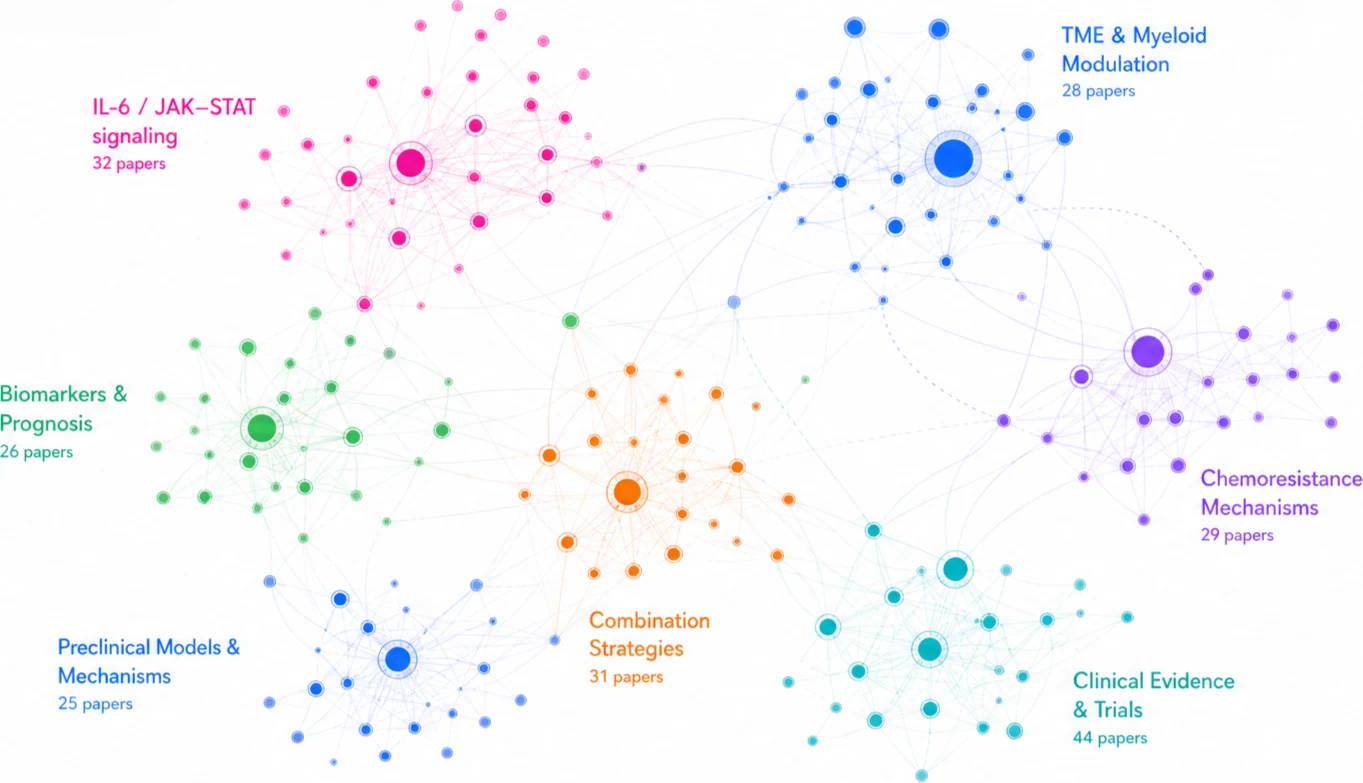
Distinctive concepts count more
Connections are weighted by distinctive shared concepts, so closeness reflects topical similarity, not citation habits.
Themes, anchors, bridges
Community detection reveals research themes, anchor papers, and the bridges that link them, plus whether each theme is rising or fading.
Built by the agent
The agent builds the map from curated, full-text sources and weaves it, citation-verified, into your brief.
Evidence you can trust
Every claim is cited, verified,
and evidence-typed
Each finding is checked against the source's full text and tagged by evidence type, and every brief gets a Trust Index.
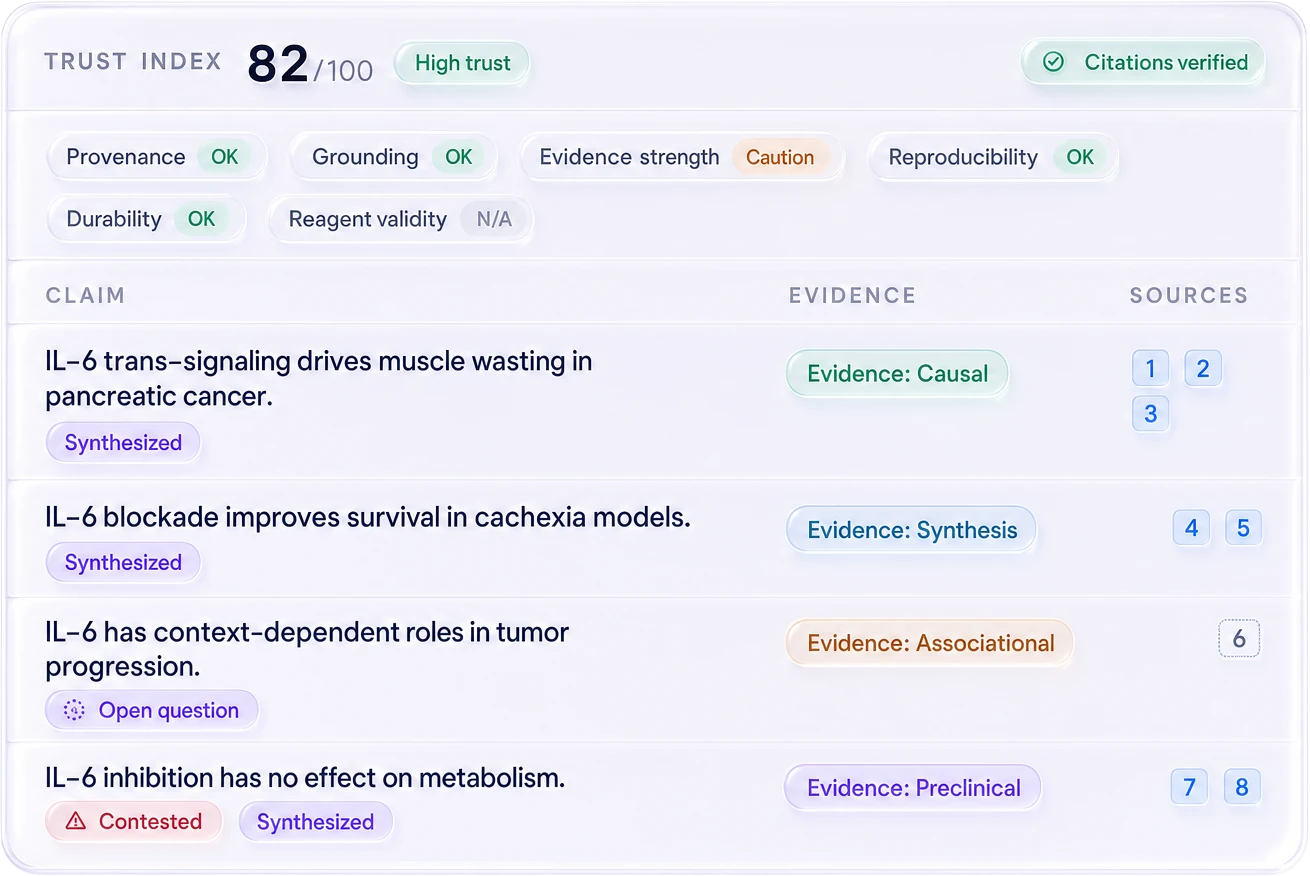
- Types every finding by evidence strength
- Verifies citations against full text
- Scores each brief on a six-facet Trust Index
- Flags claims backed by multiple sources
Evidence Watch
The literature moves on.
You get told when
A brief is true on the day you run it. Add the claims it rests on to a watchlist, and BioSkepsis keeps re-checking them against new literature, so a retraction or a newer meta-analysis reaches you before it reaches your reviewers.
3 of 5 claims still hold
but 1 was retracted, and 1 has been superseded.
- Mechanism claimReaffirmed
- Efficacy claimStill standing
- Population claimStill standing
- Dosing claimSuperseded
- Safety claimRetracted or flagged
- Re-checks the claims behind a brief daily, weekly, or monthly
- Catches retracted sources and published corrections
- Flags a finding when a newer review or meta-analysis replaces it
- Emails you only when a verdict actually changes
Lab book
Every result you interpret,
kept where you can find it
Each interpretation is saved as a lab book entry: your result beside the literature’s tally, the verdict, and the experiments that would settle it. Come back a month later and re-check it against what was published since.
- 20/08/2026METTL3 knockdown in glioblastoma cellsPartly fits
- 12/08/2026SOX2 overexpression in neural stem cellsFits
- 02/08/2026IDH1 R132H in immortalised astrocytesConflicts
METTL3 knockdown in glioblastoma cells
12 papers read in full: 8 agree, 3 conflict, 1 unclear. Trust Index 71. Next: rescue with catalytically dead METTL3.
- Your result beside the literature: how many papers agree, conflict, or are unclear
- A verdict with a Trust Index, the likely mechanisms and the caveats, kept in one place
- Re-check any entry against new papers, or watch it with Evidence Watch
Research Hub
Ideas Trends What's next
Browse citation-grounded briefs built from the literature: ready-made hypotheses, methods, and pathways to spark your next experiment.





BioSkepsis for Claude
Run a full literature review without leaving Claude
BioSkepsis is in the Claude connector directory. Ask a life-science question in any Claude conversation and get back a citation-grounded brief from the peer-reviewed literature.
Run a full review
The agent plans your question, searches the literature, and reads full text before it answers.
Evidence, not prose
Briefs come back with ranked and tiered sources, sub-question coverage, and a Trust Index.
Screened for integrity
Retracted papers, hijacked journals, and questioned cell lines are filtered out.
Keep following a topic
Turn a run into a research feed: new related papers by email, daily, weekly, or monthly.
Connect in three steps
- 1
Add the connector. In Claude, open Settings, then Connectors, and add BioSkepsis from the directory.
- 2
Sign in to BioSkepsis. Approve access with your existing account. Your password is never shared with Claude.
- 3
Ask a research question. The brief lands in your chat and in your BioSkepsis account a few minutes later.
Try asking
Does KRAS G12C inhibition improve survival in non-small cell lung cancer?
What is the evidence that senolytics extend healthspan?
Turn that into a weekly feed so I get new related papers.
A run uses one of your monthly research briefs and takes a few minutes, so it suits real research questions rather than quick lookups.
From insight to impact
From conclusions to next steps
Generate testable hypotheses and experiment designs, so you leave with a plan, not just a summary.
- H1
IL-6 blockade will reduce muscle wasting in pancreatic cancer by modulating STAT3 signaling.
- H2
IL-6-driven cachexia is mediated via myeloid cell-derived factors.
- H3
Combination of IL-6 blockade + nutritional support improves survival vs. control.